Items
-
-
-
-
-
-
-
-
Website Analysis
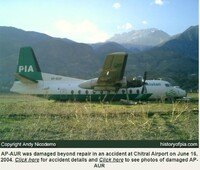
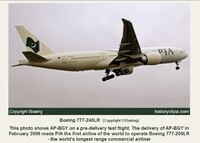
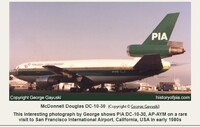
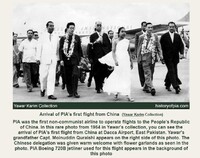
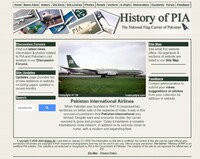
Website Analysis The website I am going to analyze for this project is historyofpia.com. It is about the history of Pakistan International Airlines supported by airplane pictures, their description, location, what type of aircraft and their period in history. The website provides a pictorial history of Pakistan International Airlines, containing pictures of old and current fleet, aircraft pictures shot in different locations across the globe, information about liveries and how it was used in different decades. The purpose of the website is not just to provide history of Pakistan International Airlines through pictures but how the airline has managed to assist in spreading the message of the nation-state of Pakistan across the globe. Since various PIA aircrafts often had Pakistan written on its fuselage, it is important to know how soft-power plays its role in the global sphere. Pakistan International Airlines takes pride in being the first non-Communist airline to start operations in the People's Republic of China. It was the first airline to operate the Boeing 777-200LR. The first page of historyofpia.com begins with a picture of a PIA aircraft, establishing what to expect from the website, history through pictures. A brief history of the airline is written underneath the image as an introduction to the viewer. The first page image changes every time an individual visits the webpage. You can navigate through the tabs located on the top of the page. They tell you where you want to visit or what you want to see in terms of aircraft pictures. “Home” is basically the main page, “Basic Facts” will lead to information like the aircraft fleet in “Fleet” as a subfield or “Livery.” The “History” field will lead to subfields like “History” or “Historic Facts” which has information about interesting historical feats achieved by the airline. As you can see, it is not linked methodologically according to years. Instead, the website is arranged through fields that have information including history and some contemporary information. “Old Days” have pictures of PIA aircraft from the past dating back to when the airline began its operations as Pakistan International Airlines, because the airline was originally called Orient Airways and renamed along with the joining of other Pakistani airlines. The color green located in every page of the website is important because it represents the national flag color of Pakistan. The important aspect of the website are definitely pictures of aircrafts and important stuff related to Pakistan International Airlines. The field itself says as it contains images of different PIA aircrafts. You have to see the pictures in order to grasp the purpose of the websites. PIA aircraft pictures in the website are not only interesting or give a particular story through pictorial lens but tells history through pictorial lens. A picture of an aircraft belongs in a moment in time. The aircraft was probably at its prime and used by other airlines to transport passengers. Now, the viewer wonders what happened to the aircraft, why was it discontinued, why the airline discontinued it, is its place being filled by PIA’s current fleet. An example I would like to share with you is this picture of a McDonnell Douglas DC10. The DC-10 is important in the history of the jet age in my opinion because its manufacturer was one of Boeing’s major competitors. The DC-10 was definitely one of the aircrafts that gave Boeing a run for its money. McDonnell Douglas folded and was bought by its rival Boeing. It now has a new competitor in the shape of Airbus, a European aircraft manufacturing company. PIA was a purchaser of the Airbus A300 and A310 aircrafts, one of Airbus’ early models. Currently, PIA operates Airbus A320s along with Boeing 777s. Airbus and Boeing may have strong competition in terms of aircraft manufacturing but their aircrafts fit well in airline fleets. The website definitely gives credit to individuals who took the pictures of PIA aircrafts. If you just navigate the website for pictures, they are almost never-ending. If you open the subfield called “Photo Gallery” you can almost keep going to see pictures as they seem never-ending. The website even highlights the low points of PIA’s history. The fields called “Hijackings” depict pictures of an aircraft being hijacked and its story related to it. The aircraft hijacked was a Boeing 720 which has been discontinued in production. It was interesting to see after the hijacking story, the aircraft was used as a fun attraction for folks visiting a park in Clifton. Another interesting fact about PIA’s Boeing 720s is that one of them is stored in a Planetarium in Karachi. I have not personally gone inside the plane but I would regularly see it when crossing the Planetarium or visiting the neighborhood. The field “Accidents” has all the documented accidents related to the airline, whether it be as small as two aircrafts colliding with no fatalities or deadly aircraft crashes. Not all recorded accidents have pictures. Some have a different aircraft related to the accident story. A picture of a Fokker F27 not involved in that accident was used to give an idea to the viewer. Information about how many passengers died and the specifications of the aircrafts are mentioned. Some pictures are not easy to digest as plane crashes can be very horrific. The latest PIA accident involved an Airbus A320 on 2020, one day before Eid ul Fitr, the first Muslim holiday of the calendar and the last day of Ramadan. It was tragic and controversial as Pakistan’s Aviation Minister made a startling allegation that most of PIA’s pilots had fake licenses which hurt the integrity of the airline, Pakistani pilots, the Pakistani Government and the reputation of the nation-state of Pakistan itself. The United States and the European Union have banned PIA from its aerospace as a result. The airline has struggled not only to gain its reputation back but become profitable again. The website does not delve much into PIA’s political problems but this statement is a tantamount of recurring political interferences for the airline. Corrupt politicians and other personalities have made profits from the airline to benefit themselves. As part of my dissertation, I plan to delve into this argument further. The website has successfully managed to cater pictures of PIA aircraft in one location. It has done a good job explaining every picture, where it was taken, who took the photograph and what aircraft it was. There is a sublink on the “In-Flight” called “Trip Reports.” One trip is documented on an Islamabad-Gilgit-Islamabad route in 2004 using a Fokker F27 aircraft. It is a detailed story about a flight that had to fly back and forth using the same crew in one day. We get a glimpse of interesting pictures of the capital city of Islamabad, the Nanga Parbat peak and the city of Gilgit itself. It was the first time I visited this particular page as not only pictures were taken for the flight journey but a story was written. That is what I call a good picture story. The tragic thing that came out was that the aircraft was involved in an accident overrunning the runway in the city of Chitral and it had to be discontinued from service. Another Fokker F27 was involved in a fatal accident in Multan where the aircraft collided with electric wires after takeoff. All Fokker F27s had to be discontinued from service. PIA replaced them with ATR 42s. The website is fairly easy to maneuver. The titles of fields and subfields tell you exactly where to go and what to expect on the website. The “Old Liveries” field provides a decade to decade or maybe a yearly pictorial description of PIA’s liveries used in different aircrafts. It even tells a story of a failed livery that was introduced in 2018 but was stopped by a Supreme Court of Pakistan order. The historiography is a little disorganized as the website does not specify the historical periods. It is upto the viewer which historical period the aircraft was taken. It seems that the theme of aircraft pictures kind of takes away the historiography as the viewer does not get much of an orderly history of the airline. Instead, the viewer is left with the fields to decide to learn about the history of PIA from its inception to contemporary. It looks like 2018 was the last year in terms of important upgrades for the airline and photographic editions to the website. “Fleet” and “Accidents” have information related to post 2018 because of the number of aircrafts PIA has and the last fatal accident occurring in 2020. While the “Accidents” field kind of tells the airline’s problems, the website overall shows a more romanticized view of Pakistan International Airlines which is contradictory to the airline’s reputation in contemporary times. The website does not have mapping features which is a disadvantage to our project. However, the availability of pictures and their descriptions gives us an important idea of how to tell history through a pictorial lens. The website has to evolve from its traditional use of graphics to a more complex use with more availability of algorithms, website designs and features. However, too much complexity may lead the viewer to be confused as he/she may find it difficult to maneuver the site. It is important to make our website project not just advanced then historyofpia.com but user friendly for individuals who require special assistance. Individuals who require visual aids may find this website difficult to maneuver. Which is why it is important to aid every individual with their specific needs. The website pays a tribute to its employees in “People.” Pictures of individuals, whether they be pilots or cabin crew are honored for their services for the airline in the website. It is important for us to give credit to individuals who assisted in designing our project. Bibliography “Historyofpia.com.” https://historyofpia.com/index.htm. “Aik Aur Haadsa. Junaid Akram.” YouTube. Uploaded 23 May 2020. https://www.youtube.com/watch?v=Dfu4VBhwi8I. The Case of Fake Licenses. Junaid Akram Podcast#65.” YouTube. Uploaded 28 June 2020. https://www.youtube.com/watch?v=aVBAIhepqMU. Mian, Tahir Imran. “Clipped Wings: How Pakistan’s Aviation Was Grounded.” DAWN. Uploaded 8 November 2020. https://www.dawn.com/news/1587854. Asghar, Muhammad. “Credibility crisis hits PIA, CAA over “dubious licenses” of pilots.” Published 26 June 2020. https://www.dawn.com/news/1565262/credibility-crisis-hits-pia-caa-over-dubious-licences-of-pilots. Justin Hayward. “The Rise and Fall of McDonnell Douglas.” Simple Flying. 4 March 2021. https://simpleflying.com/mcdonnell-douglas-rise-and-fall/. -
-
-
-
-

-
-
-
-

-
-
-
-

-
Call to Action
Screenshot of how visitors can support the Quipu Project and its narrators.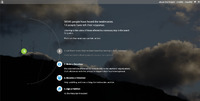
-
A Narrator's Story
Screenshot of a narrative on the Quipu Project site.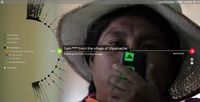
-
Quipu Project - Navigation Key
Screenshot of the navigation key for the Quipu Project site.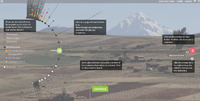
-
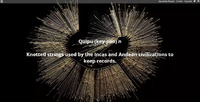
Definition of a quipu
Screenshot of the definition and appearance of a traditional quipu.